Washing your underwear the right way: Kind to the environment & your wallet
Anyone who wants to make more conscious use of resources can already make a difference through small changes at home. Cleaning, washing and especially doing the laundry are among the biggest consumers of water and energy in our homes – and this is not only due to possible chemicals in detergents, fabric softeners & Co.
by CALIDA
April 12, 2025•6 min reading time

Tips for conscious cleaning and caring for your clothes.
Table of Contents
Why washing your clothes incorrectly uses resources
Tip 1: Consider energy efficiency when buying a washing machine
Tip 2: Reduce how often you wash
Tip 3: Load the washing machine as fully as possible
Tip 4: Use lower washing temperatures
Tip 5: Pre-treat stains instead of using a pre-wash
Tip 6: Don't use too much detergent
Tip 7: Wash individual items by hand
Tip 8: Choose your detergent carefully
Find out at CALIDA why doing laundry can use resources and how you can make washing your clothes more conscious and more cost-effective. Here is a brief overview of what we will cover in more detail in our 10 tips:
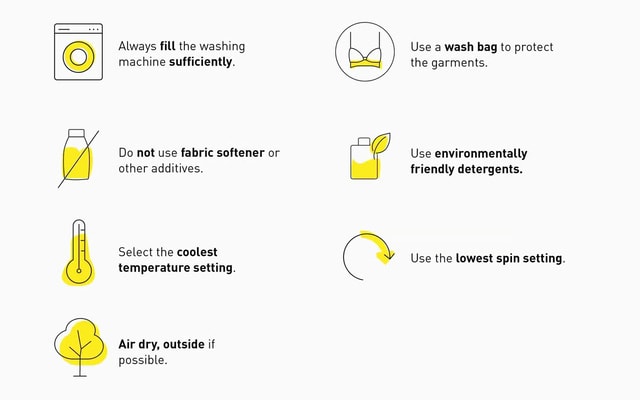
Graphic with 7 tips for washing clothes more consciously
Why washing your clothes incorrectly uses resources
For many people, doing laundry is just as automatic a process as going to the toilet every day. When you are stressed, it can therefore happen that you start a washing cycle with a smaller load or accidentally use too much detergent – mistakes that are no disaster, but are worth being aware of. After all, in addition to costly water and electricity consumption, unnecessary washing and high detergent consumption also increase our use of resources.
Detergents, fabric softeners and laundry fragrances are discharged directly into the wastewater by your washing machine. The chemicals they contain, such as surfactants or bleaching agents, can affect water quality and are not always necessary for thorough cleaning. A good reason to switch to alternative products or to make your own detergent inexpensively and without much effort; you will find instructions for this at the end of this article. But first, here are our 10 tips for conscious, cost-effective laundry care!
Tip 1: Consider energy efficiency when buying a washing machine
When buying a new washing machine, it is worth looking at energy consumption. Even if a used machine may seem cheaper at first glance, it can consume more electricity if it has lower energy efficiency. This not only makes it a higher energy consumer, but, especially when energy prices are rising, it can also become an expensive addition to your household costs. While refrigerators are already rated using energy classes from A+++ onwards, the most energy-efficient washing machines available today are labelled with energy class A.
Tip 2: Reduce how often you wash
Is your pile of worn clothes huge again, even though some items have only been worn once or twice? To clear some space from the unpopular “laundry chair”, many people decide to wash clothes even though they are neither dirty nor unpleasantly smelling. It may seem obvious, but you can significantly reduce unnecessary washing cycles by, for example, airing out worn clothes or placing them in the freezer overnight to freshen them up.
Tip 3: Load the washing machine as fully as possible
Especially with easy-care and robust textiles such as cotton or terry towels, you can fill the washing machine properly. This reduces the number of washing cycles and therefore also helps reduce water and electricity consumption. To make sure your laundry still has enough room in the washing machine, there should be approx. one fist's width of space between the drum and the clothes.
Delicate woollen garments, elegant lingerie or fine blouses, on the other hand, need a little more space in the washing machine. Thanks to the lower temperatures and reduced spin speed, these garments can also be washed in the machine; a laundry bag can additionally protect delicate garments and reduce friction. This allows you to adapt your laundry routine to the needs of each garment.
Tip 4: Use lower washing temperatures
To get clothes thoroughly clean, many people choose high washing temperatures of 60 °C or even 95 °C. However, if your clothes are not heavily soiled or contaminated, such high temperatures are often unnecessary and can increase electricity consumption while putting more strain on the fibres of your laundry. Even with underwear, and especially with delicate lace bras or sensitive briefs, 30 °C should not be exceeded. And don't worry: temperatures below 40 °C can also be sufficient for washing underwear and clothes!
Tip 5: Pre-treat stains instead of using a pre-wash
It goes without saying that the pre-wash programme on your washing machine also increases electricity and water consumption. For normally soiled clothes, this programme is often completely unnecessary and can therefore be avoided in everyday life. To make individual, heavily soiled garments look fresh without a pre-wash, proper pre-treatment can help: Use stain remover or gall soap to treat individual stains, while a mixture of water and citric acid or vinegar can be used to prepare entire garments for the washing cycle.
Tip 6: Don't use too much detergent
To keep the amount of detergent entering the wastewater as low as possible, always use only as much detergent as you actually need. You can find information on the correct dosage on the back of the detergent packaging. Since the required amount also depends on the hardness of the water in your area, there are no universal rules of thumb. However, one thing applies: The softer the water, the less detergent you need.
Tip 7: Wash individual items by hand
Of course, you can also use a lot of water when washing by hand. Before running the washing machine for just one or two items and using additional electricity, however, washing by hand can be a practical option. Individual items can easily be cleaned in the sink with warm water and a little detergent; homemade detergent is also suitable for this. Simply leave the garment to soak in the water for a short time, then gently work it through for two to three minutes and rinse it thoroughly with cold water.
Tip 8: Choose your detergent carefully
There is now a wide range of detergents with different ingredients, including products that do without many specific chemicals. In general, washing powder contains a lower proportion of surfactants and therefore has a different ingredient composition from liquid detergent or detergent capsules. There are also colour and heavy-duty detergents that do not contain phosphates, petroleum, microplastics, colouring agents, fragrances and preservatives or optical brighteners. Information on the packaging and relevant product labels can provide guidance when choosing a detergent.
Tip 9: Reduce fabric softener
Fabric softeners can affect the composition of wastewater due to their softening agents and fragrances, and they do not improve cleaning performance. Nevertheless, many people do not want to give up the fresh laundry scent and soft feel of their clothes. If you want to reduce your use of fabric softener, we recommend leaving it out or reducing its use as much as possible.
Tip 10: Dry your laundry consciously
Once your clothes have been washed, it is time to dry them. To speed up the process and save space otherwise needed for a bulky clothesline, many people use a tumble dryer. This is another electrical appliance that can consume a lot of electricity. For quick-drying laundry such as cotton, linen or towels, it can therefore be worth using a clothesline instead.
When air-dried, your clothes can dry within a short time – in direct sunlight, this can sometimes take just a few hours. If there is no other option, just like when buying a washing machine, pay attention to energy efficiency when purchasing a new tumble dryer.
Making your own detergent: Here's how!
If you would like to make your own detergent, you can do so quite easily. You will need:
1 grated bar of curd soap
1.5 parts washing soda
5-6 parts boiling water
Dishwasher salt and essential oils for a pleasant fragrance
Optional: 1.5 parts baking soda + 1.5 parts citric acid to make an all-purpose detergent
Here's how to make your own detergent:
Dissolve 1 part grated curd soap with 1.5 parts washing soda in 5-6 parts boiling water. To make an all-purpose detergent, you can also add 1.5 parts baking soda and the same amount of citric acid. A little dishwasher salt and essential oils for a pleasant fragrance are optional.
Once all the ingredients have dissolved during the first heating process, you can heat the mixture again after one hour and again after approximately 12 hours to optimise the consistency.
Add 150 to 200 ml of your homemade detergent to the washing machine for cost-effective laundry care.
Discover more interesting blog posts: